On this page
3D Map View: Explore Tactical Situations in Three Dimensions
Check common operational picture (COP) or simple military map in 3D on any device worldwide.
Overview
Visualising military plans in 3D brings many benefits. This documentation page lists the common 3D navigation tasks as panning to an area on earth, zooming to a specific military unit or task, or interactively exploring your military mission:
Start 3D View
Click the 3D button in the column of buttons at the bottom right of the map, just below Undo and Redo. Its tooltip reads Switch to 3D View (read only). In the 3D view the same button reads 2D and takes you back.

The map view will be started in 3D. By default you will fly-in to have an optimal view on the loaded operational picture (layers). Check the chapter 3D Map Navigation to learn about the supported options to change and edit the camera position in the 3D view.
The 3D view is read-only, and it removes the symbol tools from the main window. Switching to 3D takes the whole editing level away, so Add new MSS Symbol, the MSS Symbol Editor and the Point List are hidden entirely — they do not grey out, they disappear. This is the most common reason for “the Add Symbol button is gone”. Switch back to 2D and the three buttons return.
Returning to 2D: the previously active editing layer is deactivated. To resume placing or editing symbols, re-activate the layer by clicking it in the Layer-Manager — the pen icon next to the layer name indicates the active editing layer.
Military Map Layer in 3D
Identical to the 2D view, the view settings of the individual loaded MilX® layers can be adjusted within the MilX Layers Menu:
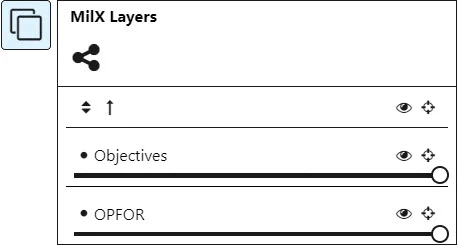
‘MilX Layers’ Menu supports the following set of functions in the 3D view:
| Icon | Function | Description |
|---|---|---|
 | Show/Hide | Hide the MilX layer from display in the 3D |
 | Zoom Layer | Zoom extent of the MilX layer in the 3D view |
 | Transparency | Set transparency of the MilX layer in the 3D view |
3D Map Navigation
Navigate with touch
The web application has been optimised to navigate the 3D Map on a mobile device using a touch screen:
| Function | Instruction |
|---|---|
| Pan (move map) | Place one finger on screen and drag in direction to move map. |
| Zoom-in | Place two fingers on screen and spread (pinch-to-zoom) |
| Zoom-out | Place two fingers on screen and pinch (pinch-to-zoom) |
| Tilt / Change Pitch | Place two fingers on screen and drag down or up |
| Rotate | Touch and drag (place two fingers on screen and rotate them against each other) |
Hint: Check the chapter ‘3D Navigation Panel’ if your mobile device does not support multi-touch events.
Navigate with mouse
Use the following functions to navigate the 3D Map on a desktop using a mouse:
| Function | Instruction |
|---|---|
| Pan (move map) | Press and hold left mouse button and drag in direction to move map. |
| Zoom-in / Zoom-out | Option 1: Use wheel button - Scroll to zoom in and out Option 2: Press and hold right mouse button and drag cursor up or down. |
| Tilt / Change Pitch | Press and hold ‘Ctrl’ key + left mouse button. Drag cursor to change pitch |
| Rotate | Press and hold ‘Shift’ key + left mouse button. Drag cursor to rotate around own axis. |
Hint: Use the ‘3D Navigation Panel’ and ‘Compass’ if one of the key combinations is not supported on your device.
3D Navigation Panel
The on-screen navigator provides camera navigation commands in a single control in the lower left corner of the web application. The explicit camera controls are useful for navigating complex content. By default, the panel is hidden and can be open with a click on the ‘3D Navigation Panel’ button:
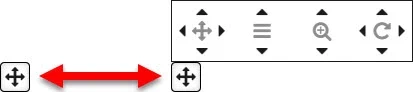
The panel provides the following functions:
| Button(s) | Function |
|---|---|
 | Move the camera in the direction of the buttons (up, down, left and right) |
 | Change altitude (move camera in the same position higher or lower) |
 | Zoom in and out |
 | Change pitch of camera to look more down or up |
 | Rotate camera to left or right |
3D Navigate Shortkeys (Keyboard Shortcuts)
The following shortkeys (keyboard shortcuts) support an even faster navigation within the 3D Map:
| Shortkey | Function |
|---|---|
| ArrowLeft | Move the camera to the left |
| ArrowRight | Move the camera to the right |
| ArrowUp | Move the camera forward |
| ArrowDown | Move the camera backward |
| ‘+’ or ‘Z’ | Zoom-in |
| ‘-’ or ‘X’ | Zoom-out |
| Shift + ArrowUp | Increase height/altitude of camera |
| Shift + ArrowDown | Decrease height/altitude of camera |
| Ctrl + ArrowLeft | Rotate the camera counter-clockwise (changes the heading) |
| Ctrl + ArrowRight | Rotate the camera clockwise (changes the heading) |
| Ctrl + ArrowUp | Look up (Tilt/Pitch up) |
| Ctrl + ArrowDown | Look down (Tilt/Pitch down) |
| ‘N’ | If you have rotated your view, reset the orientation to face north. |
Compass
Click the Compass button to reorient your scene with north straight up in your view. The compass icon is located in the bottom left corner of the web application map.army.

3D View Settings
map.army keeps a separate group of settings for the 3D view. It appears in Options only while the 3D view is active — at the very bottom of the panel, under the heading 3D View Settings — and disappears again when you switch back to 2D. Open Options (the sliders button in the left-hand toolbar) and scroll to the end of the panel:
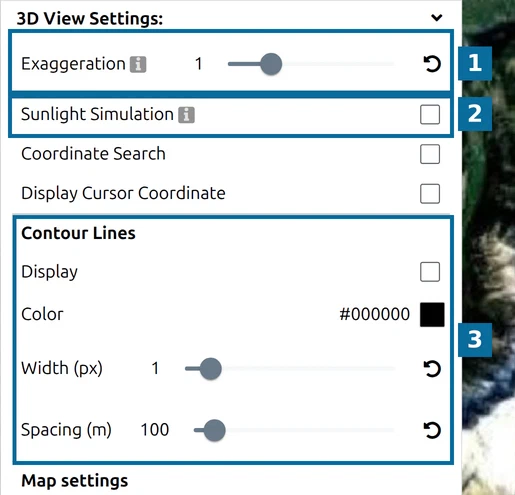
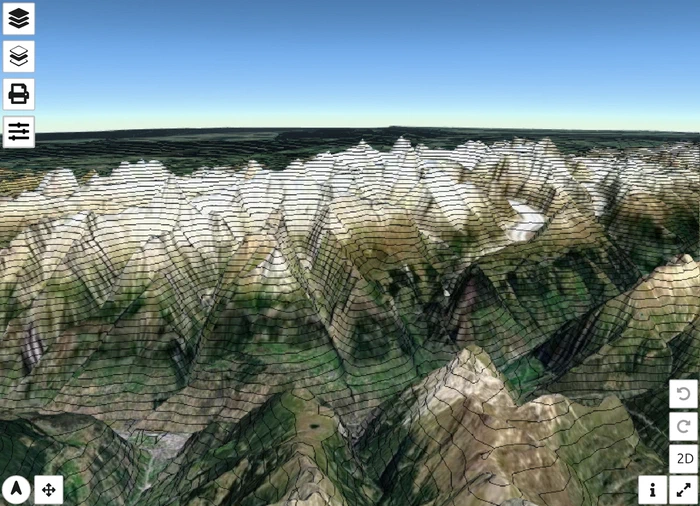
- Exaggeration stretches the terrain vertically, so that relief reads clearly even when you look at a wide area. 1 shows heights at their real scale, 0 flattens the terrain completely, and the slider goes up to 4 in steps of 0.1. The round-arrow button at the end of a slider resets it to its default.
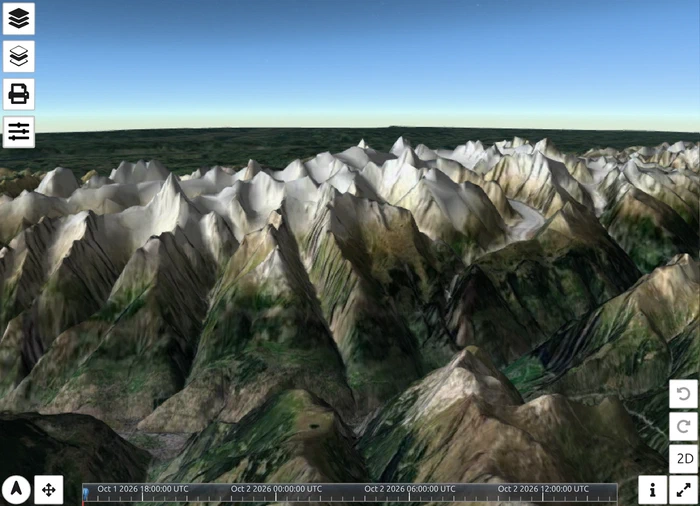
- Sunlight Simulation lights the terrain with the sun’s position for a chosen date and time. While it is on, a timeline runs along the bottom of the map; drag it to change the time and watch the light and shadows move across the terrain. The timeline shows times in UTC.
- Contour Lines draws lines of equal height over the terrain. Tick Display to switch them on; Color, Width (px) (0.5 to 5) and Spacing (m) (10 to 1,000 m, default 100 m) style them. The three styling controls are always shown, but they only take effect once Display is ticked.
The two views below show the same part of the Bernese Alps. On the left, Exaggeration is set to 2 and contour lines are drawn every 200 m; on the right, Sunlight Simulation is on and the timeline is visible along the bottom:
The rest of the group
| Setting | What it does in the 3D view |
|---|---|
| Coordinate Search, Display Cursor Coordinate | Switch the coordinate search box and the cursor-coordinate readout on or off. They work as described in Map Tools. |
| Map settings — Map Type, Brightness, Hue, Chroma | Choose the base map draped over the terrain and adjust its colours, as in the 2D Map Settings. The 3D view keeps its own values for these, separate from the 2D map — by default a satellite base map. |
| Map settings — Opacity | Fades the base map. At 0 the base map is hidden and the terrain is shown as a plain white surface. |
| Reference Lines — Color, Width (px), Height (m) | In 3D, every 1-point military symbol (except pins) is drawn Height metres above the terrain at its position — 0 to 1,000 m, default 100 m — with a vertical reference line from the ground up to the symbol. Color and Width style that line. A symbol that carries its own altitude is drawn at that altitude instead. Multi-point tactical graphics stay on the ground. |
| Coordinate Settings — Coordinate Grid and its options | Draws the chosen coordinate grid over the terrain. After you choose a grid, its lines appear only once you move the view — pan, zoom or tilt a little. Until then nothing seems to change. |
Indicate Direction
While the 3D view is active, the Symbol Format group of Options gains one more setting, Indicate Direction (on by default). For every 1-point symbol that has a direction of movement (modifier Q, see Symbol Format), it draws a 3D arrow pointing in that direction. Symbols without a direction get no arrow; untick the setting to remove all arrows. A direction of exactly 0° (due north) currently shows no arrow.
Your 3D settings are kept
map.army remembers the 3D View Settings between sessions in the same browser. They are also included in the settings file you download under Application Settings, so you can move them to another browser together with the rest of your options.
Last updated: